

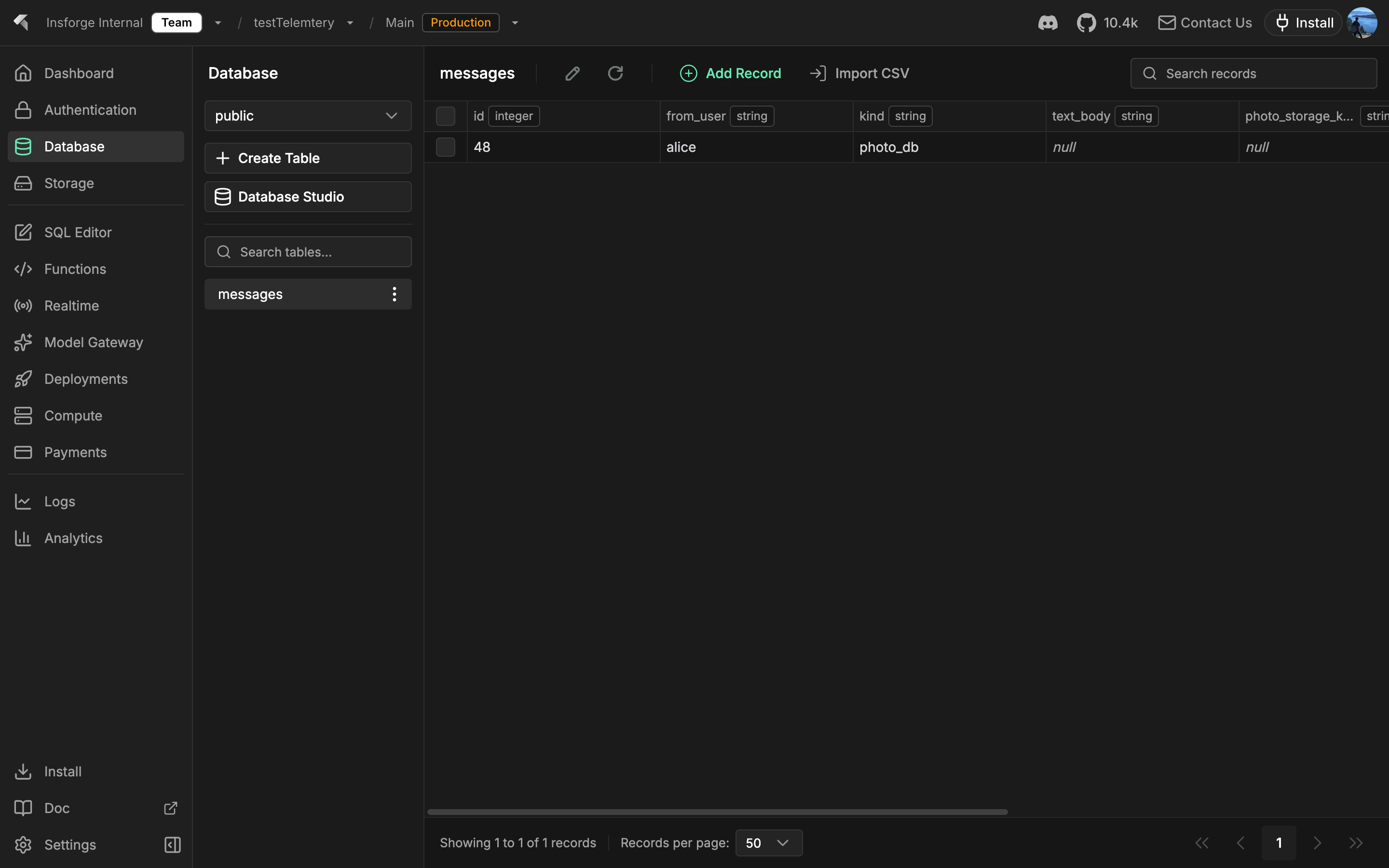
The table editor: typed columns, inline editing, CSV import, and a SQL studio.
Looking for file storage? Use Storage for images, PDFs, and other binary content. The database stores rows; storage stores objects.
Features
Tables as APIs
Define a table and you immediately get REST endpoints plus a typed SDK client for it. No code generation step. The auth JWT scopes every query through RLS.Migrations
Track and apply SQL changes in order. Migrations ship as plain.sql files in your repo, applied with npx @insforge/cli db migrations up --all or via the MCP tool.
Branching
Spin up an isolated database branch to test risky schema changes against a copy of production data. See Branching.pgvector
Native vector search for embeddings, with HNSW and IVFFlat indexes. See pgvector.Row-level security
Postgres RLS policies enforce access at the row level. Policies read the auth JWT, so the same rule applies to REST queries, SDK calls, realtime subscriptions, and storage requests.Concepts
Migrations
Apply SQL changes in order, safely.
Branching
Isolated databases for preview and risky changes.
pgvector
Vector search for embeddings.
Build with it
TypeScript SDK
Typed queries, inserts, and updates from Node, browser, and edge.
Swift SDK
Native Swift database client for iOS and macOS.
Kotlin SDK
Coroutines-first database client for Android and JVM.
REST API
Plain HTTP database endpoints, callable from any language.
Next steps
- Set up the CLI to link your project (the recommended path).
- Browse the TypeScript SDK reference for typed queries.